24
Defining national debates
300
In live audience + national broadcast
30M+
Beneficiaries in the country
What is The Trial Debates
In Summary
The Trial Debates is a program piloting a new format of debate (termed a QFA debate format) as an alternative to current parliamentary style of debate. This new debate format will facilitate stronger democratisation today, by promoting:
- Greater inclusiveness in, or allowing citizen-led, public policy or legislative debates;
- Higher consensus-building (thus helping to mitigate toxicity and conflict) in politics;
- Increased intellectualism in public policy or legislative debates; and
- Greater responsiveness to the needs and demands of citizens.
The program is a series of public policy debates for television, which test the new debate format, to inspire and derive lessons for later parliamentary and constitutional reform.
The QFA debate format (employed in The Trial Debates) is able to achieve the above objectives because it uses a structure of proceedings similar to a court trial. It focuses on cross-examinations as the main driver of debate (allowing truths to be unearthed more easily, in a decorous environment) while also ensuring high levels of cooperation amongst debating parties. In contrast to the conflict which characterises other debates today (be it parliamentary or television debate), the goal of debate in the new QFA format is to arrive at agreed conclusions or verdicts at the end of the day, by making parties work towards concessions, truths and common understanding.

The Problem
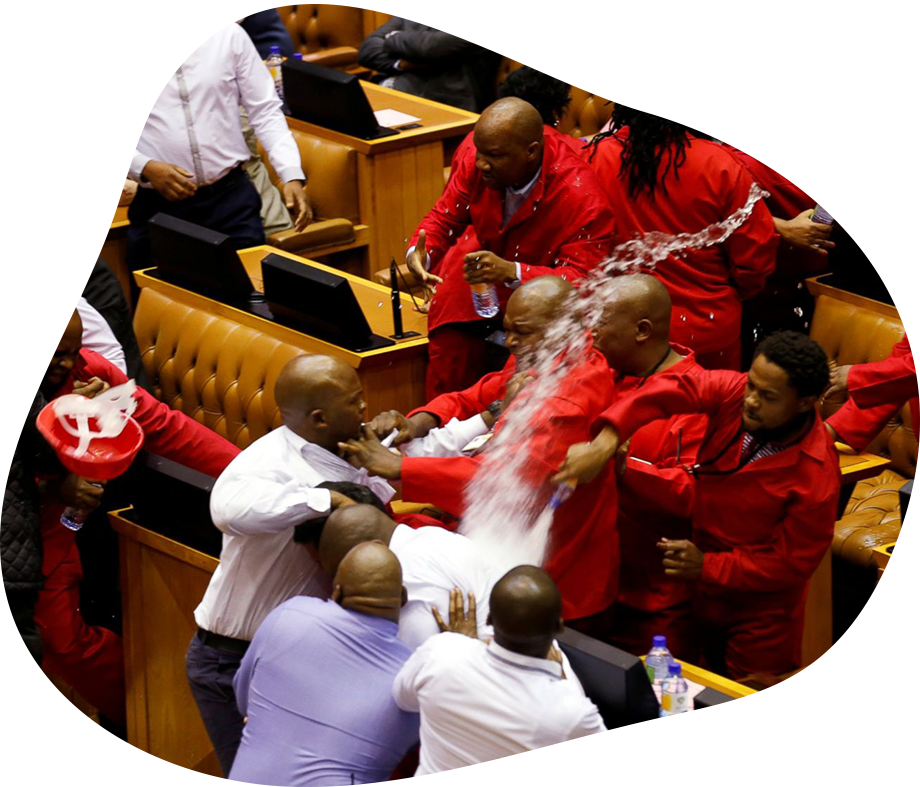
Presently, debates in our parliaments are adversarial, and mostly entail long presentations by individuals sharing their side of an argument. Whether or not such arguments are sound, in spite of some opportunities for questioning, is often left to stand, because the opposing party may also present their side of the argument.
What we end up having, often, therefore, are several independent arguments, that may very well be seen as noise, both audibly and information-wise; where parties easily talk past each other, and where truths can get mixed up with misdirection, evasion, or flawed reasoning, assumptions or interpretations, or outright falsehoods, at the end of which votes are expected to be cast based on how one feels about the presentations all-in-all.
This is more pronounced in the United Kingdom Parliament, for example – the mother of all parliaments – where, in many sessions, participants rise and speak spontaneously and rapidly, with cheering and heckling, creating nothing short of commotion.
Due to this environment and the “laissez faire approach” to debate used, and other problems with our system of governance and politics itself, voting in parliaments boil down to predispositions. The debates only serve to reinforce pre-existing positions, hardly ever changing other parties’ minds at the end of it, and achieving little by way of creating a space for constructive engagement and dynamic outcomes.
In sum, parliamentary debates presently do nothing to encourage any real effort by the parties to work together towards a common understanding, truth and/or logical conclusions.
These are the observations and one of many problems author Fuseini Yakubu identifies with our current structuring of democracy, in his book The Tragedy Called Democracy in the 21st Century (2023); which offers recommendations for redesigning the system of governance, including the format of debates used in national assemblies.
This program is piloting recommendations from the book on how debates in our national assemblies should be designed, by encapsulating the proposed design as an engaging, entertaining and educative television program which also offers a vital learning opportunity around this new format of debate, to be carried forward into future implementation or constitutional reform.

The Solution: a QFA Format
Termed a Question for Answer (QFA) debate format, the proposed debate format focuses on cross-examinations as the main driver of debate. It uses one small question after another to construct (or deconstruct) arguments or proposals; with rules that ensure questions cannot be evaded, and in a process that enforces interconnectedness or layering of arguments. It is designed to eliminate any and all flawed reasoning (or logical fallacies) in arguments, ensuring that the resulting ideas from debates are as sound as can be and as agreeable to all as possible.
It is based on the idea that a series of logical facts or truths can only lead to a logical conclusion or truth, and a conclusion based on flawed logic can only be flawed itself (other things being equal). Every law, policy or new systems proposal, therefore, must be based on a line of reasoning, or key arguments, which justify the proposal or conclusion. If the component or key arguments are flawed, the conclusion or proposal itself must be flawed; unless proven by some other means. An argument must not proceed or build on top of a premise or assumption which is proven to be flawed, especially if subsequent arguments rely heavily on the truth of that premise or assumption.
So, for example, if a party argues for the replacement of a country’s constitution in its entirety while another argues for amendments only or none as the best way forward for the country: one of these arguments must be true and the other false; one superior to the other. In typical debates today (be it parliamentary, TV, seminar or other debates), either party may present their answer to that question, after which audiences are expected to judge based on how they feel about the presentations as a whole. In the QFA debate format, however, the parties must probe each other’s answers further, to discover which is flawed and which is superior, by taking each apart to try to understand its reasoning or gaps, and the linkages between the key arguments, separating fact from fiction, in every single sentence, methodically and progressively, until a logical or common conclusion is unearthed or arrived at.
It employs a structure of proceedings similar to what we have in courts.
The process is also designed to allow for, and encourage, cooperation between debating parties.
The goal is to arrive at a single conclusion or verdict at the end of the day, by working towards concessions, and a common truth or understanding by all parties.
A progressive and proper line of questioning does not only unearth irrefutable truths or robust ideas or solutions at the end of the day. A proper line of questioning, while it deconstructs and seemingly pokes holes in others’ arguments, also helps uncover and discover perspectives, and invite considerations. Done right, the process actually becomes an exercise in building common understanding and constructive engagement, producing a more educative or enlightening debate or platform for all parties involved.
You can learn more about how this debate format works by studying the:


What Makes it Different
- Parliamentary Debate
- Relies on “presentation for presentation;” that is, comparing individual presentations
- Reinforces opposition or conflict; due to the “presentation vs presentation” comparison
- Characterised by commotion
- Questioning sessions, if any, are not progressive or layered, and are sometimes a series of questions for a series of answers
- Does not work towards a single conclusion
- QFA Debate Format
- Relies on cross-examinations; that is, sifting through for answers from both positions
- Encourages parties to work towards agreement, concessions and understanding
- Characterised by order and decorum
- Questions take a layered, step-by-step or progressive approach to deconstruct arguments towards eventual truths
- Works towards a single conclusion or verdict
Compared to Other Debates
- TV, Forum, Seminar etc. Debate
- Relies on journalists to question parties
- Relies on “answer for answer;” that is, comparison of answers as is to decide
- Reinforces opposition or conflict; due to the “answer vs answer” comparison
- Prone to commotion (in TV debates)
- Questions are not layered and progressive
- May run through various topics in a single sitting, resulting in short answers
- Does not work towards a single conclusion
- QFA Debate Format
- Relies on parties to question each other
- Relies on cross-examinations; sifting and making deductions from each
- Encourages parties to work towards agreement, concession, understanding
- Characterised by order and decorum
- Questions are layered and progressive
- Deals with a single problem, expanding it into greater detail and education
- Works towards a single conclusion or verdict

Objectives and Benefits
A. The QFA Debate Format
The objectives of the QFA debate format (which this program is piloting) are, towards the goal of promoting true democracy or stronger democratisation, to promote:
- Greater inclusiveness in, or allow citizen-led, public policy or legislative debates;
- Higher consensus-building (thus helping to mitigate toxicity and conflict) in politics
- Increased intellectualism in public policy or legislative debates; and
- Greater responsiveness to the needs and demands of citizens.
B. The Trial Debates, as a Pilot
The objectives of The Trial Debates program as a pilot (of the QFA debate format) are:
- To verify if the QFA debate format achieves its objectives (that is, provide proof of concept);
- Granted objective (1), to open citizens’ minds to how differently democracy can work (in being more inclusive, cohesive and constructive), to inspire needed constitutional reform; and
- To derive lessons from its initial implementation, to be carried forward into future reform.
C. The Trial Debates, as a TV Program
The objectives of The Trial Debates as a television program are:
- To explore solutions to major governance challenges in our country;
- To offer public education on various topics which will be explored in-depth by experts in a logical, theoretical or scientific manner, away from the usual politicisations; and
- To produce a more entertaining and engaging debate program than audiences are used to in other debate programs, due to its unique format.